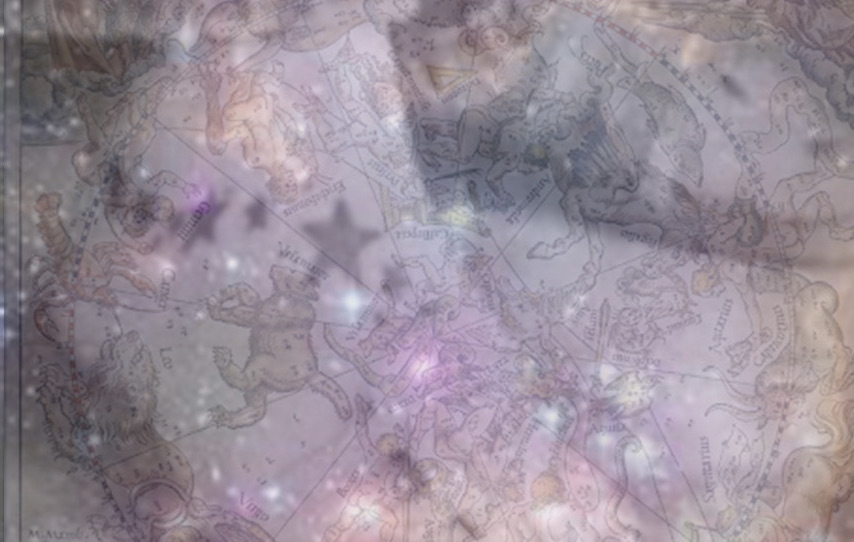
Alternative Constellations by Julie Lunde

The Astronomical Woman . . .

is planetary and huge, looming large, with as many moons as fingers, or stars. Every day she crafts a careful chignon, twisted in on itself like an ampersand, leaking bobby pins. From behind she is always saying yes, and?

Orion’s Belt . . .

must be heavy on his hips, I think, to carry that much light—to hold the sun. His is an hourglass figure, a magazine might say. Cigarette pants are forbidden. Stick to darker hues, nothing too tight. Avoid at all costs anything bright across the span where you are wide. It is ill-advised to string Christmas lights here. His hips should be hidden, cloaked in the black night—to draw the eye to his other assets, broad shoulders, long legs. Perhaps his outline is better suited to a pregnant woman, said to be glowing, but our model not concerned with trends or flattery struts his span for us.

Star-Smugglers . . .

have an impossible task—they shine too hard to hide, dead giveaways, their glow is a smoking gun spilling starlight out of pockets, caught red-handed with a burn from handling; serving up sneers with a shrug, with a smug smile, taunting. They are rude, obsequious; they love you for letting them be snide. They are terrible at hiding and seek, but good at lying. It is a lucrative business, this grave-digging; the pay will pay off just swell.

Mars . . .

Bars and milky ways, penny candies for galaxy hitch-hikers. Thumbs-ups flag down black hole portal taxis; prices are astronomically low here (but Uber rates are sky-high—few stars can drive). Sweeteners taste sweeter at this height; the addicts warn of sterilized star-Splenda that’ll eat you from the inside out. Orion tempted too many of these, his sore sweet tooth always hungering for cavities, for emptiness to fill a hunger for empty calories and empty things, cupboards and calendars, Saturday nights.

Vertigo . . .

The star that is afraid of heights knows real pain—he has made his home in a bed of fear, sinking his teeth deeper into doom, settling down in this hated real estate, praying for a break. He broods, he counts the paralyzed seconds between first lights and last night’s crazy heyday. He sleeps at dawn. He paces his concrete pavement, grey-blue; dancing up a melancholy streak, the fluttered hands flap in distress, the five extremities splay in shivers, in quivers, etc. He says et cetera aloud. He thinks nothing of it.

___________________________________________________________________________

Julie Lunde works at Penguin Random House and writes in her small Brooklyn apartment. Her previous works have been published in Typishly, Underwater New York, and Tikkun Magazine, among others. Visit her at julielunde.com for more.

“Alternative Constellations” is a guide to the rarer figures of astronomy. I like to think of this piece as the celestial version of Matthea Harvey’s Mermaid Poems; the cast of characters exist somewhere between sky and Earth, providing commentary on the above as much as the below.

BREATHE FREE PRESS ARCHIVE

OUR STORY

Experience zigzags leaps, regresses then spurts forward, tosses frays delays surprises. Narrative revisits manifestation in countless iterations recounted since the Big Bang. Machinations of living breathing striving to make meaning from days and nights of existence. Morning provides for itself.

Breathe Free Press is a place for the essay in every imaginable, inventive form, cross-genre—flash—critical—experimental—travel in particular the lyric essay. 

Narratives are a metronome to mark time: This happened, it happened often and repeatedly with some variations on different backdrops. Most often it happened on the planet Earth. Once and only once did it happen on the moon. Einstein’s space-time theory challenges our belief in the illusion of past, present, and future. The illusion, Jean Baudrillard cautions against in Simulacra and Simulation, is the normalization of empty signs of representation.

Breathe Free Press delights in essays testing patterns of perception. We appreciate attentiveness to language and cultural associations. Essays that transform and transgress metanarratives of authority and power structures. Essays to subvert imposed constraints of genre conventions.

Some man, at some time, dominates the human psyche with his emotional ignorance. It is almost as if fate colludes with tyrants to taunt our complacency into action.

Breathe Free Press challenges the normalization of regressive tropes of renascent authoritarianism, illiberal, nationalist power threatening to reverse progress. We publish essays that allude, intimate, insinuate, attempt, analyze, critique, and express through compassion and awareness.

No weapon was ever lifted, no peace ever made, no society ever founded in silence. Liberal and illiberal movements form on the page. Modernism repurposed and reinvented representation on the ashes of the material, human, and spiritual devastation of two world wars.

Breathe Free Press is an online journal of literary resistance for essays that channel the spirit penned in dog-eared spiral notebooks, in smoky subterranean basements. Nietzsche and Buddha’s conscious narratives were composed of the rhythm of protest that lit the fuse for epochal cultural change.

MISSION STATEMENT:

Breathe Free Press, a literary magazine of essays: Essays of resistance, imagination, and social awareness. The personal made global, and the global made personal.

A STUDY OF THE BLASTULATION OF PURPLE by Tamlin Thomas

1.

All people start out as a blastula. The root of blastula is Greek for to bud or to sprout. Some sprouts are green but humans begin at purple. Blastulation starts with the number two, but our cells expand at multiples of four until the molecules add up to human. All life is divisible by four; that is, we can be reduced to infinitesimal quadratic equations whose points of origins all point back to purple.

2.

I cannot remember my father ever touching purple. His hands are wide with long fingers like a garden rake, always bent to scrape at keyboards stiffly. He has touched brown leather billows of antique cameras, the gray fur of a seven-toed cat named Miles, and the orange copper circuitry of model rockets, but never purple. Maybe that is one reason I wore purple so often as a child. I think I was hoping he would hold me.

3.

The teeth of the Rocky Mountains are purple. The Rockies extend into Las Cruces where I was born. The desert around me was burnt orange but the mountains and I were born purple, erupting from the center of the earth where purple things melt into magma. I inherited three things from my mother; blue eyes, which are Dutch, small hands, which I think might also be Dutch, and Jesus, who was not Dutch but might have been Turkish. Nothing she gave me was purple. Still, I came by my purple naturally by way of the mountains and my constellation, Aquarius, whose birthstone is the purple amethyst.

4.

There is a mollusk in the Mediterranean which bleeds purple. The shellfish are squeezed until the color is rendered, a shade which Moses referred to as Argaman. Tekhelet was also purple, but the modern Bible erases that color and calls it blue. This is important because tekhelet is closer to Cerulean, which is like blue but also like purple. Since purple is not primary, transcription altered the god tongue to say blue. In the Talmud, tekhelet is still sacred. In the Crayola Crayon Box, tekhelet is one of seven shades in the family of blue.

5.

Purple lives in middles. Blue is for boys and pink is for girls, but purple is transgender. I was born purple but dressed in pink. I think pink is fine, and blue is nice also, but I prefer the transient nature of purple, the way that purple cannot be forced to make a decision. I like how purple lies on the horizon line on the tops of mountains or oceans and how, when the sun is setting, purple marks the dusky places on the sky map between the land of indigo night and lapis day.

6.

There are many names for purple. Here are some of my favorites: Lavender. Amethyst is the stone of the star I was born under. Mauve. Heliotrope is a hairy bush that produces the tiny fronds used for kings. Mulberry is a type of berry used to make the fruity syrups served out of orange bottles at IHOP. Orchid. Pomegranate is often more red than purple, and the seed is pulpy white, but the middle of the kernel is purple. Pomegranates have a million tiny hearts that look like my foster mother’s toenails.

7.

The translucent membranous filaments of bat wings are purple when they are stretched in flight. Some butterfly wings have purple spots like bird plumage or the skins of poisonous snakes. When my dog plays outside, she morphs into purple. She slips down hillsides and her back muscles fold like waves under a black coat that shimmers purple in certain shades of daylight. Many animals turn purple when you aren’t looking, like cats, who carry secrets in their paws to lick when they are bored or when people quit paying attention.

8.

The underworld is purple. Hades is purple, and the River Styx. Caves absent of light are purple with drops of water like glow stars. In some caves, there are shrimp which have no eyes because they see by hearing. These cave shrimp branched off their sister shrimp which live just outside the caves; bejeweled eyes developed for sight. The two species of shrimp used to have offspring, but then they differentiated. The two families, separated by a rock wall, have mutated away from one another so that one lives in a world of blue sun and the other circles a purple moon pool.

9.

I used to own a corduroy suit made entirely of purple. I wore it every day, and when the suit was dirty, I made sure to carry something purple. A button, or a piece of paper in my pocket, so that I would always be a prince. The overalls I wore were purple, and the silk button up shirt underneath. I had a pair of purple boots that I would march over the sidewalk and sing these boots are made for walking. My sister would dance with me. We purpled up and down the hill between our house and the deli counter where we purchased the following items; salami, which is pink, and blueberry flavored rock candy, which looks blue on the stick but paints lips to match my boots.

10.

There’s a poem titled, “When I Am Old,” it is about aging and purple. I think everyone should wear purple as much as possible. We should not wait until we are old or stop when we are no longer women. My father’s mother, who I called Nemo, accidentally dyed her hair pale purple with a tinted horse hair conditioner. Nemo’s hair was silver, and the lather was purple, and when she came out of the bathroom, she looked like that species of faeries who age backward. Her silver hair glowed purple in the desert sun. When I’m an old man, I’ll wear purple as well, but I will shave my head for contrast.

11.

My foster mother died of liver failure after battling breast cancer for fifteen years, when we placed her in the oven her toenails were purple with silver glitter sparkles. My foster sister and I had painted them purple the day before after we rubbed her swollen ankles with lavender lotion to move the blood up into the heart. Water pools at the feet, and so does purple, leaving bruises like roses petals of the soul.

12.

The places where purple does not live interest me. Ideas and colors become valuable only because of the places they cannot be found. Here are some words which mean the opposite of purple; Stark. Lowborn. Bald. Achromatic, which is to say an absence of color entirely, including but not limited to purple. Simple. Prosaic. On the color wheel, the opposite of purple is yellow. Daisies. Daffodils. The inside of an unripe peach is yellow. Lemon peel. Nicotine stains. Depending on how you spin the color wheel, purple can be mistaken for pink. Pink is the opposite of green. Limes. Some apples. Certain types of worm.

13.

The artist formerly known as Prince decided to be the color purple, and then he became a symbol. I think it’s interesting that we can be people and symbols and anything other than a name and still the world will recognize us. Maybe we see purple before we see the person, or maybe purple is the spec that floats on an iris designating the presence of the soul.  I am not certain because I have always had trouble looking people in the eye. I have wondered if my inability to look at people straight on makes them think I am a liar. Half-truths and lies are purple; a floating value that hovers between absolutes like Prince hovered between being a person and being a symbol.

14.

My foster mother’s toes turned purple by death, but my birth mother loathed purple. Maybe that is why purple is my favorite color. Our house was devoid of purple and all related shades of lavender and even some pinks my mother deemed too gaudy. She loves yellow, the sorts of yellow that pierce your eyes and make your teeth ache. I had a pair of lavender colored glasses I wore throughout the house, rendering my mother’s world in a subversive purple palette.

15.

A liver looks purple but is closer to brown. Gray eyes turn purple if the person wears purple or pink or certain shades of blue. In some countries, blue does not exist but is considered a shade of green or purple or pure white. Imagine sitting on the shore of a beach, toes anchored in white sand. You point upwards and say, look at how purple the sky is today. How lavender. How amethyst. And look how blue the clouds are when the sun has reached its zenith.

16.

When I think of purple I think of small things people leave on the side of the road, things that were valuable but that got forgotten once they were used up; lottery tickets, wedding rings, chewed gum, soda cans, and dead mothers. We use a great many things we do not keep because when their use is done we forget their value. The shadows left behind from where we once cared for a thing or a person have a purple sort of sadness, a weight like the drapes hung on the bedposts of a dying man. We sling memories off for storage and leave the things we do not need any more in piles like rags.


Tamlin Thomas is a Creative Writing and Graphic Design student at Maharishi University of Management. As a trans gender man, Tamlin’s hybrid pieces often focus on themes of gender and sexuality as well as family life, science, and religion. Tamlin has previously been published in the Austin Community College literary journal, The Rio Review, as well as the Maharishi University blog. Tamlin is a member of Soapbox Speakeasy, a spoken word group delivering topical poetry in the small Midwestern town of Fairfield, Iowa.

THE SIGNS IN 100 WORDS by Alaina Symanovich

Aries, the pontificator

Be hypocrisy.  Be the dark whispered from the roofs.  I tell you, my friends: kill.  You have no place to be merry.  God demanded your life, your body, your splendor—you!  Set your heart on worry, little flock, for your Father has been pleased to give you to the thief.  Be ready for burning.  Truly, I tell you, he will recline at the table in the middle of the night when you least expect him and beat and cut to pieces and bring fire on you.  Peace on earth?  No, division.  Daughter against daughter against the law.  Be reconciled to prison.[i]

Taurus, the awakening

Cornsilk hair, eyelashes batting fast as hummingbird hearts, lips loose enough to lose your secrets.  I pocketed you, my seed of a dream of a hope.  (Seed dreamy hopes of me; dream seedy hopes of me.)  Some dreams we run for, some dreams we hide from.  In other words, I have unpocketed you.

If you return to me, Taurus, return to my past.  Reassure me that everything I did not know then, I sorely needed to know, but so did everybody else.  Kiss me so I believe I’m spectacular, as and more and less spectacular than everybody else you’ve ever pocketed.

Gemini, the rash

His celebration swallowed the known world.

(Does each century face morning?  The stars are certain that not one human has ever chumped the sky.)

A Plaza, a Tower, a Castle.  Sword and spear.  Ego.  Luck.  His pinstriped-suited body, the Billionaire American dream.

(How did that happen to us?)

Perhaps we built glass fantasies.

(The swaggering capitalists look positively happy, not a trace of anguish or self-conflict or guilt.)

All lives in the hand basket.

“I won’t lose a penny,” he said, a twinkle in his eyes—that was the scary thing.

But perhaps a soul was too much to ask.[ii]

Cancer, the love

Everything is dank ass: pick up the dank ass vacuum and clean this dank ass carpet of this dank ass dirt.  Everything is izz: I lizzove you, you’re the bizzest, you’re so dizzamn beautiful.  Everything is wrinkled noses and wrestling on stained sheets and wrenching the covers back from you on your tossy-turny nights.  Everything is puttering coffeemakers and sticky kitchen counters and guinea pigs wheeking at midnight and your dirty Birkenstocks by the door and my lace underwear waiting on the bureau.  Everything is this home, is this code, is this sleep-drunken sex to the melody of your breath.

Leo, the haunted

You are drunk, all curves.  You see their heads—eyeballs, small moons glowing.  You stamp both feet.  Glitter in your lap, drifting dust.  Your nose running.  Again and again this terrible bleat.  You watch for a while like a bride.  Something stabs in your side.  The breathing behind you, shallow and fast.  A ghost bites you on your shoulder and you struggle and flail.  It’s Night of the Living Dead. 

You tell him some of what happened.  What can you tell him?  You wanted to fix what you had broken.

Some things stay with you.  The dent in your nose.  The ruin.[iii]

Virgo, the stalemate

I say you don’t, didn’t, wouldn’t; the script says you can’t, couldn’t, wished to.  Look at me: quibbling over semantics as if they’re the editors of history.  History is film and I am documentarian!  If you don’t like my show, erase yourself from the cast credits.  You already have? I already have?  Again: semantics.

Even if I rewind the tape, the negatives are still there.  Even if I erase the tape, I am still here.  You can’t end scene and not expect to be recast.  (I excised you and felt nothing.)  Your part is here.  (Why won’t you play it?)

Libra, the sensation

You’re a secret in a place with no gold.  You’re witness to everything shattering.  You fluff your blonde bangs and someone across the country shudders with jealousy.  You’re miserably fulfilled, you say.

You’re a silent island of haunting; you’re a moonbow at noon.  You’re perfect as an old black hat. You’ve begun to want your strangers back.  You’re considering strapping into yellow stilettos and hiking to the Hollywood sign—though, of course, you’ve always detested yellow.

You’re wondering aloud why stars aren’t visible from L.A.  You’re denying my answer of light pollution.  You’re fiddling with your false eyelashes, yawning, craving.

Scorpio, the engineer

According to the ever-credible zodiacspot.com, you, Scorpio, are my, Leo’s, biggest heartbreaker. I waited, and Waiting for Scorpio was dramatically anticlimactic in that you never came, in that I made do with those who did, in that I stayed suspended in the neither-here-nor-there for entire acts of my life.  Only upon inspecting my nave of waiting did I find you, or rather your fingerprints stroked over every wall and window. Somewhere in the unknowable crevices of your past, you imagined this sanctum for me, this shelter, this kingdom without a matriarch.

I imagine I have become a matriarch unto myself.

Sagittarius, the idol

Those who hurt you will eventually screw up themselves & if you’re lucky, God will let you watch.

Watch out for Regina George in sheep’s clothing…

I mean, how would you feel if, at the lowest you’ve ever been, someone kicked you even lower?

You need someone new to try and bury.  

Thinking, “yeah, yeah, yeah.  This chick is full of shit.”

And, you know, just another way to play the victim.  It definitely got her a lot of attention the first time.

I feel like me, and Taylor Swift might still have sex.  Why?  I made that bitch famous.[iv]

Capricorn, the cherished

Our friendship bracelets: two heart-halves with jagged middles, puzzle pieces that fit together seamlessly.  Those shiny heart-halves were emblazoned with kindred (yours) and spirits (mine): you selflessly accepted kindred because I deemed the word too hideous to dangle from my wrist. Remember girlhood in all its restless sparkle, like so many sequins reflecting fluorescent light, like powdered sugar snowed over the kitchen floor?  Remember how we unceremoniously gave one another up?  Rightly so, for spirits can age out of girlhood, and kindred can dull into indifference, but a keepsake sheltered in the velvet drawer of a jewelry box is forever.

Aquarius, the mistake

Self-inflicted injuries rumored to hurt more than you: safety-pinning an eyeball; grinding a molar to grits; scissoring off the tip of the tongue; power drilling through the trachea; hammering the collarbone; plying off a nipple; roto-rooting through the belly button; igniting the pubic hair; shooting both kneecaps; skinning oneself with a fork; tweezing off each toenail.

For months, strangers leaned deep into my eyes and whispered where does it hurt? But I couldn’t answer wherever she is because my tongue had molted into my gums and my teeth had become thistles, and I couldn’t breathe without recalling how you had kissed me.

Pisces, the wish

You interpreted my coal-eyed compliment as an insult.  With soft hands and wiggling feet, you looked out the window and said it was snowing, and I said no, it cannot be, we live in the desert.  Custard crusted your corduroys; you pointed and said, look, frost.  You said you wanted a heart until it hurt, so I said I hurt.  You called me a stick in the mud, and I said there was not any mud in the desert, and you said my snow must have turned the dirt into mud, and I said let’s lie down, then, and we did.

[i] An erasure of Luke 12 (NIV).

[ii] An erasure of Gary Smith’s 1989 article “Donald Trump,” which appeared in People.

[iii] An erasure of Jon Loomis’ “Deer Hit.”

[iv] All lines taken from celebrity interviews, Tweets, and songs about Taylor Swift.


Alaina Symanovich studies creative nonfiction in the MFA program at Florida State University. Her work has appeared in Sonora ReviewSuperstition ReviewQuarter After Eight, and other journals.  Her essay “The M Word,” first published in Fourth River, was awarded Best of the Net in 2016.

Author Statement:

“The Signs in 100 Words” was inspired by the myriad astrology articles shared across social media sites; she wanted to transform the genre, which usually includes broad-strokes descriptions of or predictions for people, into an account of people she knows (or knows of).
TARGET by Anna Keeler

My world was colored with odd numbers and sickled blood cells; for the life of me, I could never make it stop. The rest of me compartmentalized in maladaptive bones too lumpy for my arms and a brain produced milk for a lanky ovary. A brain that is repeatedly told that it is artistic, that it is bohemian, that it is gifted, gifted, oh so gifted for its age. It is no wonder it has been put to fanatical use.

This brain came with a Rolodex and a calculator, a camera and color pallet. It also came with a lifetime warranty: On Asperger’s, OCD, the disposition for schizophrenia.

/No wonder it never fit inside my head.

This too full brain is attached to this too small body that was bred in the backseat of a JEEP Cherokee. The girl who came with it was wanted but wasn’t. Was stillborn, but wasn’t.

/Poor baby, everyone knew I would be fucked up.

These fibers and marrow glands and not quite indigo eyes survived conception – or rather – digestion, after being rinsed and spun in pills like the spin cycle. That fetus survived long enough to grow arms and legs and make it out of the womb, even if I was purple to the touch.

I watched my body grow, then stop growing. Be exposed, then hidden. I watched, waiting for that brain to pulse out of my eyes. I waited twenty-two years for the day tears turned to brain juice, spilling the bits of untreated illness onto the table.

/There can’t be anything wrong with someone who should not be here at all.

When I caved, I caved hard and became a rabid animal, metaphorically chained out in the backyard like the bastard child I am. The collar around my neck turned my skin lilac. The neighbors chucked rocks over the fence while laughing. My tears were the reminder – I am a threat to the world. Later realized, the real threat was to myself.

Other beasts built on neologistic legs were thrown into my line of vision.

I do not deserve protection.
I do not fight back.

/I’m delusional. This pain only matters to me.

Even when the collar is gone, kicked to the curb, covered in urine, the world is still lopsided and in pain. Every odd number incurably composite; every hand that could not touch I now want wrapped around my neck. This girl that survived realizes vulnerability is not precious. I am smart enough to relish in pain. I wish I were a simple girl. Numb. Dumb.

A girl who felt the curls around cheeks, whose pink cheeks have sucked a dick for a McDouble deluxe, still considered brave even when my boots pulverized rained-on flower crumbs. A girl who could stomp my brain to mush in an ostentatious display? The rocks that had busted my head that now roars with applause?

/The target of protection and love and not assault.

What I get is a set of eyes that see a tapestry in skin, and a brain crushed with the yearning to hang mutilated arms from the walls. I wait for the skin to resurrect from the partition. But I can’t resurrect what should not be there. The blood stained paint tells the world I was created.

/Still a fuck up, but I do ‘fucked up’ well.


ANNA KEELER is a poet and fiction writer living in Winter Park, FL. Her published and future work can be found in Poets.org, Deep South Magazine, Cleaver Magazine, After the Pause, The Indian Review, Pegasus Magazine, and more.

AUTHOR STATEMENT:

My essay “Target” began as a short project in a setting where my troubled, heavy writing was glorified. I was unwell and my writing reflected that, still, all I got was praise for digging into the gritty and dujour. One day, I told someone my ‘writing secret’ — trauma and mental illness, and in response was told I was lucky that those things happened so I could write the way I do. I don’t do creative nonfiction or lyric essay too often, but this is a piece I keep coming back to; despite the amount of writing I’ve done, this is a telling of my most authentic self, which both excites and terrifies me in sharing this.

SYNTAX by Samuel Cole

As a boy, I listened carefully to my parents who talked openly in the kitchen about everything. I was rarely the topic of conversation: a face seated at the table; a vexation with a big appetite; a house pet who wore my father’s ski-slope nose and my mother’s bottom-heavy ass; a creaky fulcrum on which their tiny world swung. And missed. Sometimes they laughed. Oftentimes they stared at each other menacingly, as if to erase the other altogether.

When I turned ten, I sat atop the kitchen table to practice spelling words. My parents didn’t yell me off the table or point me upstairs. Invisibility: a word I could spell, define, and draw upon. With refrain.

One night, creating a top 10 favorite vocabulary list of 1991, I overheard my mother ask my father, “I wonder if rain ever wishes to be something other than wetness.”

  1. WETNESS

“God, you’re dumb,” he said, leaning against the baker’s rack. “Rain becomes snow if the temperature gets low enough.”

  1. TEMPERATURE

“How cold does it have to get before that happens?”

“It depends on the amount of humidity in the air and the rate at which precipitation falls. Do you know nothing besides pea pods and chicken?”

“Don’t be mean to me.”

  1. PRECIPITATION

“Speaking of rain.” His voice turned cavernous. “I’m feeling a downpour coming on myself.”

  1. DOWNPOUR

“Henry.” My mother snapped, stirring with a spatula pea pods and chicken. “Don’t be a pervert.”

  1. PERVERT

“Said the biggest dick tease in high school.” He laughed.

“Miriam Bensworth was the biggest dick tease.” My mother turned around and threw a dishtowel at his crotch. “I was the biggest seduction.”

He threw back the dishtowel which landed on my mother’s face before it fell into her hands. “Miriam Bensworth was a dick thesaurus who knew all the freakiest words to explain everything I needed,” he said.

  1. FREAKIEST

“Miriam Bensworth was a classless slut.”

“No.” My father shook his head. “She was simply unwilling to change her character.”

“It’s time we both got over her.”

“Still threatened, I see.”

“A rose isn’t threatened by a skunk cabbage.”

“You, a rose.” He stepped forward and wrapped his fingers around my mother’s waist. “No, I don’t think so.”  He squeezed her neck. “But you and your ways won out.”

7. ROSE

“You can be so vile sometimes.”

“Say it.” He squeezed. My mother stood quiet, her cheeks turning red. Water poured from the faucet as he slapped her ass. Over and over. He buried his lips in her cleavage. She shrieked. Her boobs jiggled like Jello. “I said say it.”

  1. CLEAVAGE

“You said last time was the last time.”

“I lied. Now say it.”

She stared at the floor, and whispered, “Whore.”

“Now come upstairs so I can show you what a real rainstorm looks like.”

  1. WHORE

My mother turned off the stove and covered the pan with a dinner plate while my father’s face took on the wild lust my sexual adulthood would become. Embedded. Combative. Disturbed. So very.

  1. UNWELL


Samuel Cole lives in Woodbury, MN, where he finds work in special event/development management. He’s a poet, flash fiction geek, and political essayist enthusiast. His work has appeared in many literary journals, and his first poetry collection, Bereft and the Same-Sex Heart, was published in October 2016 by Pski’s Porch Publishing. His second book, Bloodwork, a collection of short stories, will be published in 2017. He is also an award-winning card maker and scrapbooker.

INTERVIEW UNDER CAUTION by Nicole Yurcaba

In due course, we’d have caught you anyway.

This time, you can’t snap another tear-stained selfie, can’t post it to Twitter bearing the hashtag
#bitchyoudidthistome

Arrested.
Threatened with another trip to her Majesty’s prison—a six-month course:
The Consequences of Violating One’s Police Information Notice.

Do you scream the f-word?
The investigation room is no place for you to Facebook-smear it followed by the c-word accented by your ex’s name.

What have you learned? asks the constable.

In this Big Brother Burlesque not even an assumed female alias protected you.

You did it out of love, you say, remembering how Warpaint’s “Love is to Die” fueled
slander-laden messages forwarded to her new employer.

What kind of love? It must have been a sick sort, offers the constable.

Do you remain silent?
Remember: silence can and will be interpreted.

It should be.
She had asked you to leave her alone.
Asked you to not contact her.
Told you not to email.
And then she ceased texting, calling, emailing.

You were the one who literally pushed buttons.

A pause. Light. Dim. You raise your head.

Do you admit the offense?

You’ve built your record, established it on incidences meant to cause distress, induce fear. Already, the transcripts, emails, screenshots bear their teeth against you.

Well? demands the constable.

A pause. Light. Dim. The steel chair. The table.

You hang your head, and you mutter, “For fuck’s sake. This isn’t like how it is in the movies.”


Nicole Yurcaba is an Instructor of English at Bridgewater College. Her poetry and essays appear in The Atlanta Review, The Lindenwood Review, West Trade Review, Chariton Review, Literature Today, and many other online and print journals. She is the author of Hollow Bottles, a chapbook reflection on human futility, music, and nature.

Author Statement:

“Interview Under Caution.” It was inspired by the two years I spent as a cyberstalking victim, and basically, depicts how I imagined the police station scenarios went each time my ex was arrested and charged.

Dear Dad You Remind Me of Trump by Diane Payne

We all have skeletons in our closets. Hell, I’ve been dead nine years. Ain’t that enough?

After years of being relatively free of you, I am sinking into a dark depression, a depression I didn’t know was possible.

I never wanted to leave my daughter with you. Ever. And then one day you were on the road and stopped by my home, and I had to go to a function at work, and you and your wife insisted on watching Ania. I felt sick all night.

Remember Cesar Chavez.  A Mexican dad.  As a young teen, I stood in front of Meijer’s alone, begging people not to buy non-union grapes.  I went on and on about the living conditions of migrants. People stopped to ask why I didn’t have friends, something to do.  I stood there alone, Dad because you said that it was good. I cared about Chavez, but you wouldn’t stand in front of no grocery store.

You had a fit if we bought a pair of Levis.  We had to wear union-made clothes. When I bought my first car, an old Honda, you yelled, Don’t park no Nip car in my driveway.

You’d be yelling about NAFTA, jobs going overseas, kind of the same way you ranted about the boys I dated:  How can you date a Nip?  What, you think you’re too good to date someone from a factory? You have to date that boy from that fancy school?  What, now you’re dating a taco bender?  What, you got pregnant by a black man?

Your geography skills didn’t extend too far from Michigan, except for when you gambled in Atlanta City, then retired in that trailer park in Yuma.  But Dad, I met the father of my child in India.

When I got home, you were watching basketball, summer Olympics, and Ania asked me:  “Mommy, what’s a spook?” Then the two of you said to me after I expressed my anger at your blatant racism. I didn’t know that was racist, did you?

But this isn’t why I’m writing Dad.  You’ve been dead nine years, and now, it’s like you’ve come back to life. Had you been alive and sitting there in the kitchen, I wonder what you would have said. You’d probably agree our country needed a damn wall around Mexico.

At first, I could tolerate the rants, but when we saw the video over and over and over about grabbing pussy, him laughing about it with his friend, my tolerance ended, and I felt physically ill.

I remembered you and your gas station friend talking about swapping your daughters for sex. Me. Your daughter.  You said this in front of me in the basement. You boasted about how you used me sexually.

But, what I really worried about was, did you try to put my nine-year-old daughter on your lap?  Did you try to do anything to her beneath a blanket while you sat on the couch?

Yeah, I know. I get it, Dad. We all have skeletons in our closet. Your lame excuse for abusing me for years. Do you honestly think most people have those kinds of skeletons, Dad? Maybe you are right: There are a lot of men like you.


Diane Payne is the author of Burning Tulips (Red Hen Press) and co-author of Delphi Series 5 chapbook. Her publications include: Obra/Artifact, Map Literary Review, Watershed Review, Tishman Review, Whiskey Island, Kudzu House Quarterly, Superstition Review, Blue Lyra Press, Fourth River, Cheat River Review, The Offing, Elke: A little Journal, Souvenir Literary Journal, Madcap Review and Outpost 19. She is the MFA Director at the University of Arkansas at Monticello.

Author Statement:

During the election, I felt sickened every time I saw that video where Trump boasted about grabbing women by the pussy. It dawned on me how Trump reminded me of my father.  I wrote this because I have a feeling many people see Trump as their father and may feel this same repulsion, this same agony, this perpetual disappointment, this lingering grief.

YOUR WORDS, NOT HIS by CHELSEY CLAMMER

He fucks you in second-person, pays for your objectivity.

You are his editor, after all, and that’s what an editor is paid to do; be unbiased, attentive to the actual words. His words.

Yet every “you,” sounds personal. How not to think they’re your holes he creatively fucks, are the things he wants to stuff with his junk? (His words. Not yours.) But this should be about craft and technique. Pace and perspective and tense and so you shouldn’t tense up when he sends an essay titled, “I Want to Fuck You.” This is creative nonfiction and you aren’t being paid to be propositioned. The monthly PayPal-ing he does to you is not sent To Friends and Family, but For Goods or Services.

He wants your goods.

What service do you provide?

You edit his essay—sickened—then send it back with more of your red ink on the page than his black. “Track Changes” to get him off your course and back on track. Craft and technique. Pace and perspective and tense. Don’t explore subtext. Just focus on prose. Remember?—he pays for your objectivity.

You are his object.

That thing he wants to fuck from every point of view.


Chelsey Clammer is the author of Body Home and winner of the 2015 Red Hen Press Nonfiction Manuscript Award for her essay collection, Circadian. She has been published in The Rumpus,  Hobart, McSweeney’s, and Black Warrior Review among others. She is the Essays Editor for  The Nervous Breakdown and a volunteer reader for Creative Nonfiction. She teaches creative writing online with WOW! Women on Writing, and received her MFA from Rainier Writing Workshop. www.chelseyclammer.com.

Author Statement:

I’m a really, REALLY huge lyric essay nerd, so most of the time my writing focuses more on pace, rhythm, structure, tone, and specific word choice as the key aspects of telling a story.