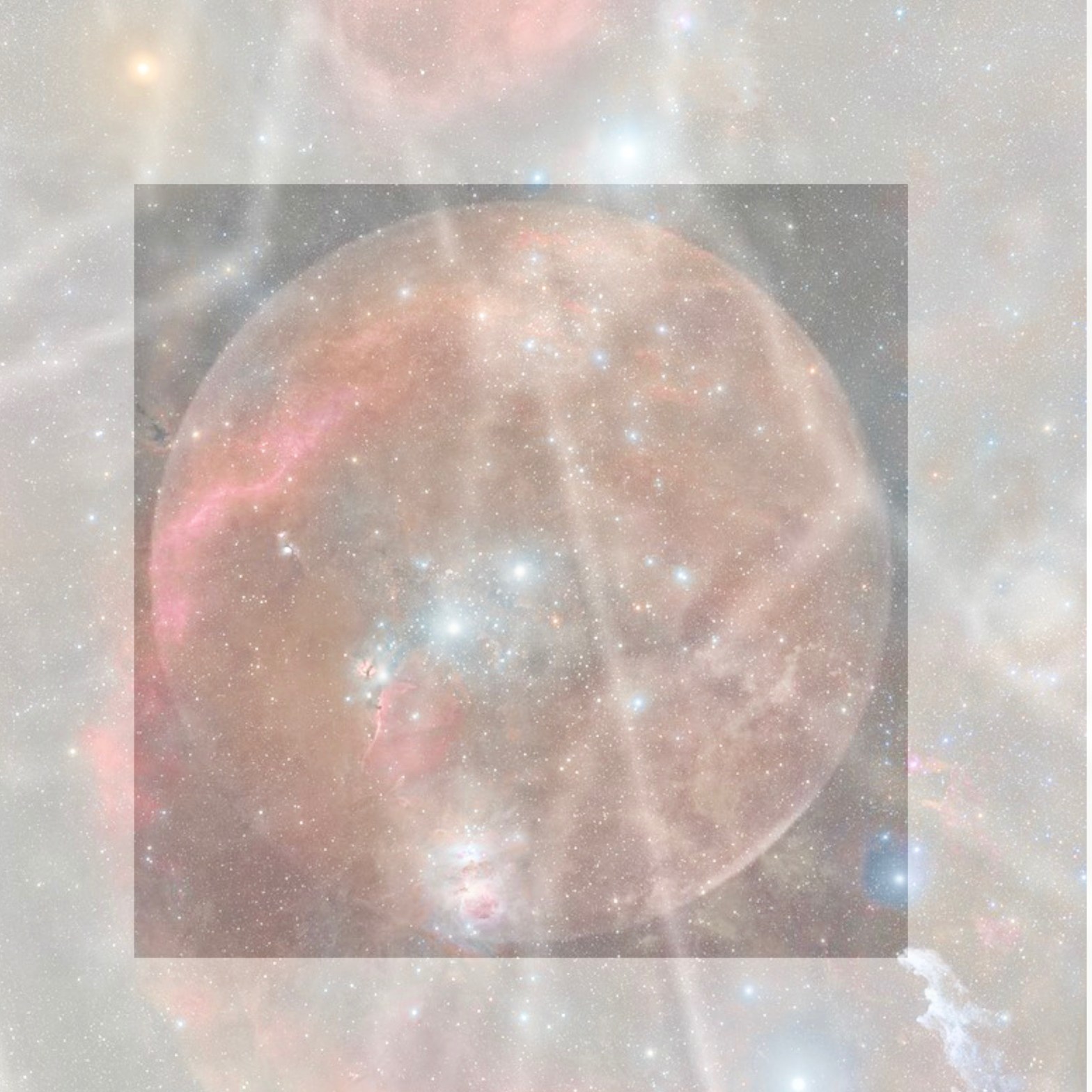
Alternative Constellations by Julie Lunde

The Astronomical Woman . . .

is planetary and huge, looming large, with as many moons as fingers, or stars. Every day she crafts a careful chignon, twisted in on itself like an ampersand, leaking bobby pins. From behind she is always saying yes, and?

Orion’s Belt . . .

must be heavy on his hips, I think, to carry that much light—to hold the sun. His is an hourglass figure, a magazine might say. Cigarette pants are forbidden. Stick to darker hues, nothing too tight. Avoid at all costs anything bright across the span where you are wide. It is ill-advised to string Christmas lights here. His hips should be hidden, cloaked in the black night—to draw the eye to his other assets, broad shoulders, long legs. Perhaps his outline is better suited to a pregnant woman, said to be glowing, but our model not concerned with trends or flattery struts his span for us.

Star-Smugglers . . .

have an impossible task—they shine too hard to hide, dead giveaways, their glow is a smoking gun spilling starlight out of pockets, caught red-handed with a burn from handling; serving up sneers with a shrug, with a smug smile, taunting. They are rude, obsequious; they love you for letting them be snide. They are terrible at hiding and seek, but good at lying. It is a lucrative business, this grave-digging; the pay will pay off just swell.

Mars . . .

Bars and milky ways, penny candies for galaxy hitch-hikers. Thumbs-ups flag down black hole portal taxis; prices are astronomically low here (but Uber rates are sky-high—few stars can drive). Sweeteners taste sweeter at this height; the addicts warn of sterilized star-Splenda that’ll eat you from the inside out. Orion tempted too many of these, his sore sweet tooth always hungering for cavities, for emptiness to fill a hunger for empty calories and empty things, cupboards and calendars, Saturday nights.

Vertigo . . .

The star that is afraid of heights knows real pain—he has made his home in a bed of fear, sinking his teeth deeper into doom, settling down in this hated real estate, praying for a break. He broods, he counts the paralyzed seconds between first lights and last night’s crazy heyday. He sleeps at dawn. He paces his concrete pavement, grey-blue; dancing up a melancholy streak, the fluttered hands flap in distress, the five extremities splay in shivers, in quivers, etc. He says et cetera aloud. He thinks nothing of it.

___________________________________________________________________________

Julie Lunde works at Penguin Random House and writes in her small Brooklyn apartment. Her previous works have been published in Typishly, Underwater New York, and Tikkun Magazine, among others. Visit her at julielunde.com for more.

“Alternative Constellations” is a guide to the rarer figures of astronomy. I like to think of this piece as the celestial version of Matthea Harvey’s Mermaid Poems; the cast of characters exist somewhere between sky and Earth, providing commentary on the above as much as the below.
BREATHE FREE PRESS ARCHIVE

OUR STORY

Experience zigzags leaps, regresses then spurts forward, tosses frays delays surprises. Narrative revisits manifestation in countless iterations recounted since the Big Bang. Machinations of living breathing striving to make meaning from days and nights of existence. Morning provides for itself.

Breathe Free Press is a place for the essay in every imaginable, inventive form, cross-genre—flash—critical—experimental—travel in particular the lyric essay. 

Narratives are a metronome to mark time: This happened, it happened often and repeatedly with some variations on different backdrops. Most often it happened on the planet Earth. Once and only once did it happen on the moon. Einstein’s space-time theory challenges our belief in the illusion of past, present, and future. The illusion, Jean Baudrillard cautions against in Simulacra and Simulation, is the normalization of empty signs of representation.

Breathe Free Press delights in essays testing patterns of perception. We appreciate attentiveness to language and cultural associations. Essays that transform and transgress metanarratives of authority and power structures. Essays to subvert imposed constraints of genre conventions.

Some man, at some time, dominates the human psyche with his emotional ignorance. It is almost as if fate colludes with tyrants to taunt our complacency into action.

Breathe Free Press challenges the normalization of regressive tropes of renascent authoritarianism, illiberal, nationalist power threatening to reverse progress. We publish essays that allude, intimate, insinuate, attempt, analyze, critique, and express through compassion and awareness.

No weapon was ever lifted, no peace ever made, no society ever founded in silence. Liberal and illiberal movements form on the page. Modernism repurposed and reinvented representation on the ashes of the material, human, and spiritual devastation of two world wars.

Breathe Free Press is an online journal of literary resistance for essays that channel the spirit penned in dog-eared spiral notebooks, in smoky subterranean basements. Nietzsche and Buddha’s conscious narratives were composed of the rhythm of protest that lit the fuse for epochal cultural change.

MISSION STATEMENT:

Breathe Free Press, a literary magazine of essays: Essays of resistance, imagination, and social awareness. The personal made global, and the global made personal.

The Heart of Poetry by Ai Aida

All words represent things only when there is a perceiver. Put another way; they are nothing until the perceiver shows up to decode and render their meanings. But even then, after the advent of the conscious mind, words are still forever empty. “I” for example, is devoid of content not only because it’s a pronoun which substitutes for a noun and which is literally nobody until somebody uses it, but because when one says/writes “I am a mother” or “I am a student” the word “mother” (m-o-t-h-e-r) or “student” (s-t-u-d-e-n-t) has no relevance whatsoever to the very thing it signifies. For words are not the things themselves and are empty of everything that is. This lack of thingness or is-ness is expressed in Buddhism as sunyata (a Sanskrit word for emptiness) and articulated in the following passage of the Heart Sutra:

Form is emptiness, emptiness is form

Emptiness is not separate from form, form is not separate from emptiness

Whatever is form is emptiness, whatever is emptiness is form

This emptiness is not only real but also physical because it is this emptiness –or the nothingness of things– that we feel when we touch flowers with our hands or when we soak our feet in water. We never come in contact with the “flowers” or the “water” but only with their reality; that is, their nothingness or their indescribable-, unsayable-, unnamable-nature. And the purpose of the above passage is to make us realize this fact so that we can transcend words/language and be free from the suffering caused by the linguistic “game” whose rules we created but with which we tie ourselves down endlessly.

Now, my question is: What is poetic language? And my answer to this is: It’s a language that is beyond language and therefore is closer to the emptiness or the nothingness of things mentioned above. In poetry, there is no fixed signified behind the signifiers which work on multiple levels and which are forever open to interpretations as they renew themselves every time they are read. The poetic words are meant to speak the silence of existence, no matter how impossible or contradictory that may seem. In this sense, it can also be said that the poet is someone who serves her end when her voice is no longer hers. The poet’s work belongs to the Universe. Poetry is the absence of the poet, and the poet is nobody in her poetry.

___________________________________________________________________________

Ai Ebashi (pen name: Ai Aida) is a Japanese-born writer and translator, who holds an M.A. in English Language and Literature from Istanbul Yeditepe University and an M.A. in English Literature from San Francisco State University, and who is currently an M.F.A. candidate in Creative Writing at San Francisco State University. Her plays have been seen in the Bay Area, California, and her poems, translations, short stories, non-fiction stories, and illustrations have appeared in New American Writing, National Geographic, Di-Vêrsé-City Anthology and Mainichi ga Hakken Japan, among other publications. She is a winner of the Leonard Isaacson Award Browning Monologue Contest and The Austin International Poetry Festival 2017. She has previously worked as a translator, journalist and children’s book author in Turkey, where she lived for seven years, and presently works as a Japanese language teacher and as a Creative Writing instructor at San Francisco State University.

SYNTAX by Samuel Cole

As a boy, I listened carefully to my parents who talked openly in the kitchen about everything. I was rarely the topic of conversation: a face seated at the table; a vexation with a big appetite; a house pet who wore my father’s ski-slope nose and my mother’s bottom-heavy ass; a creaky fulcrum on which their tiny world swung. And missed. Sometimes they laughed. Oftentimes they stared at each other menacingly, as if to erase the other altogether.

When I turned ten, I sat atop the kitchen table to practice spelling words. My parents didn’t yell me off the table or point me upstairs. Invisibility: a word I could spell, define, and draw upon. With refrain.

One night, creating a top 10 favorite vocabulary list of 1991, I overheard my mother ask my father, “I wonder if rain ever wishes to be something other than wetness.”

  1. WETNESS

“God, you’re dumb,” he said, leaning against the baker’s rack. “Rain becomes snow if the temperature gets low enough.”

  1. TEMPERATURE

“How cold does it have to get before that happens?”

“It depends on the amount of humidity in the air and the rate at which precipitation falls. Do you know nothing besides pea pods and chicken?”

“Don’t be mean to me.”

  1. PRECIPITATION

“Speaking of rain.” His voice turned cavernous. “I’m feeling a downpour coming on myself.”

  1. DOWNPOUR

“Henry.” My mother snapped, stirring with a spatula pea pods and chicken. “Don’t be a pervert.”

  1. PERVERT

“Said the biggest dick tease in high school.” He laughed.

“Miriam Bensworth was the biggest dick tease.” My mother turned around and threw a dishtowel at his crotch. “I was the biggest seduction.”

He threw back the dishtowel which landed on my mother’s face before it fell into her hands. “Miriam Bensworth was a dick thesaurus who knew all the freakiest words to explain everything I needed,” he said.

  1. FREAKIEST

“Miriam Bensworth was a classless slut.”

“No.” My father shook his head. “She was simply unwilling to change her character.”

“It’s time we both got over her.”

“Still threatened, I see.”

“A rose isn’t threatened by a skunk cabbage.”

“You, a rose.” He stepped forward and wrapped his fingers around my mother’s waist. “No, I don’t think so.”  He squeezed her neck. “But you and your ways won out.”

7. ROSE

“You can be so vile sometimes.”

“Say it.” He squeezed. My mother stood quiet, her cheeks turning red. Water poured from the faucet as he slapped her ass. Over and over. He buried his lips in her cleavage. She shrieked. Her boobs jiggled like Jello. “I said say it.”

  1. CLEAVAGE

“You said last time was the last time.”

“I lied. Now say it.”

She stared at the floor, and whispered, “Whore.”

“Now come upstairs so I can show you what a real rainstorm looks like.”

  1. WHORE

My mother turned off the stove and covered the pan with a dinner plate while my father’s face took on the wild lust my sexual adulthood would become. Embedded. Combative. Disturbed. So very.

  1. UNWELL


Samuel Cole lives in Woodbury, MN, where he finds work in special event/development management. He’s a poet, flash fiction geek, and political essayist enthusiast. His work has appeared in many literary journals, and his first poetry collection, Bereft and the Same-Sex Heart, was published in October 2016 by Pski’s Porch Publishing. His second book, Bloodwork, a collection of short stories, will be published in 2017. He is also an award-winning card maker and scrapbooker.